Vegetable oil immersion
A single-phase immersion tank was installed in August 2026 in the machine room of IDRIS (CNRS), on behalf of the Centre de Calcul et de Données du Plateau de Saclay (CCDPS), which pools the computing and data resources of IP Paris, Université Paris-Saclay and IDRIS.
It is not a machine dedicated to one workload: it is a generic hosting demonstrator, in which power consumption, density and recoverable heat are measured.
Why a vegetable oil
Common dielectric fluids are synthetic hydrocarbons or fluorinated compounds, the latter of which the European Union is moving to restrict as PFAS.
The demonstrator uses a plant-based ester, not classified as hazardous, bio-based and biodegradable. The question is therefore not only a thermal one: it concerns the end of life of the fluid, fire safety and supply dependency.
The density of HPC, cloud and AI workloads now exceeds what air cooling can remove without an energy penalty. Immersion captures the heat in liquid form, and therefore in a usable form.
The setup
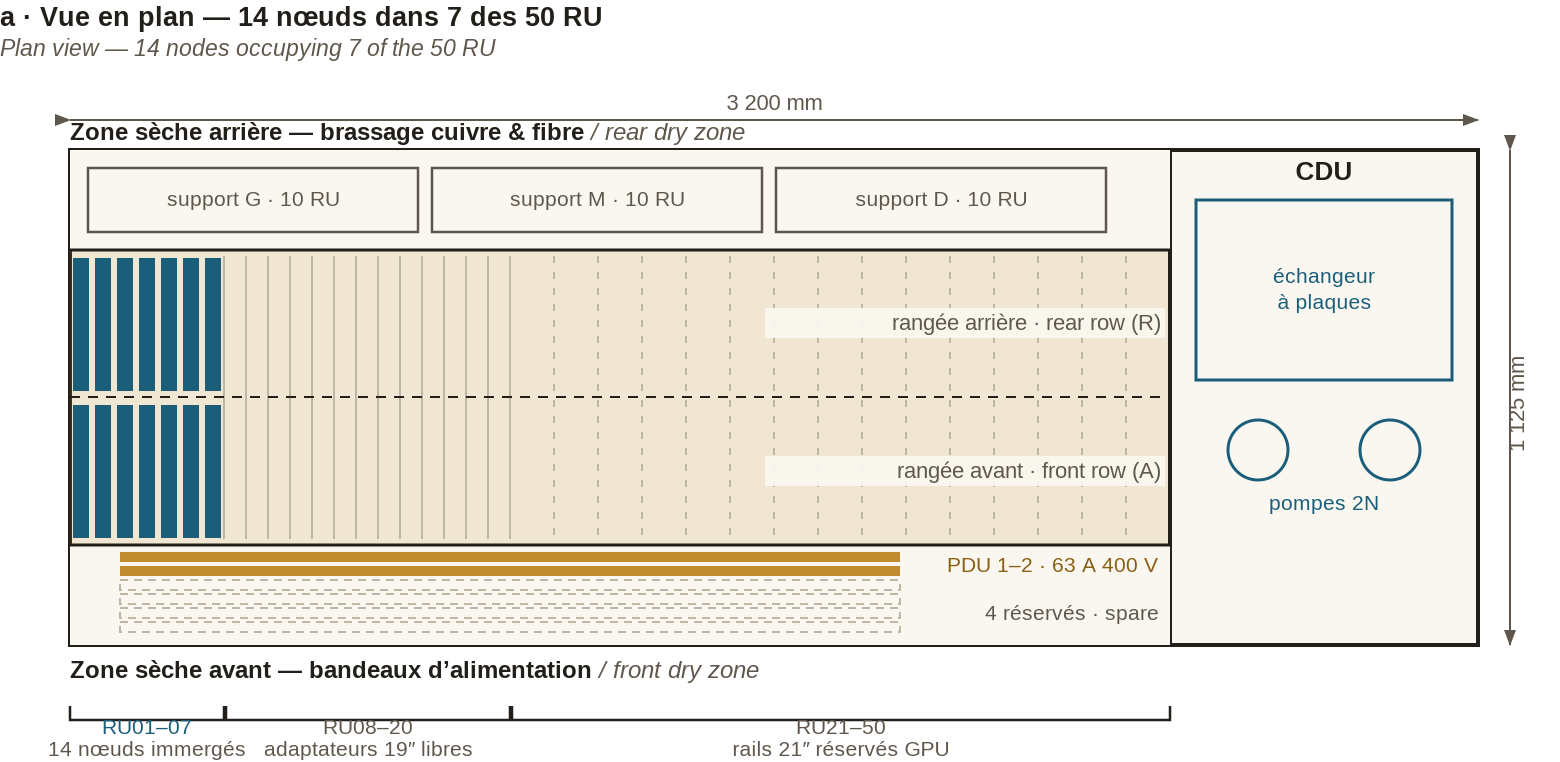
Submer SmartPod EXO S200 “Unitank” tank, 50 usable RU, 3,200 × 1,125 × 1,826 mm, CDU included, 1,159 kg empty.
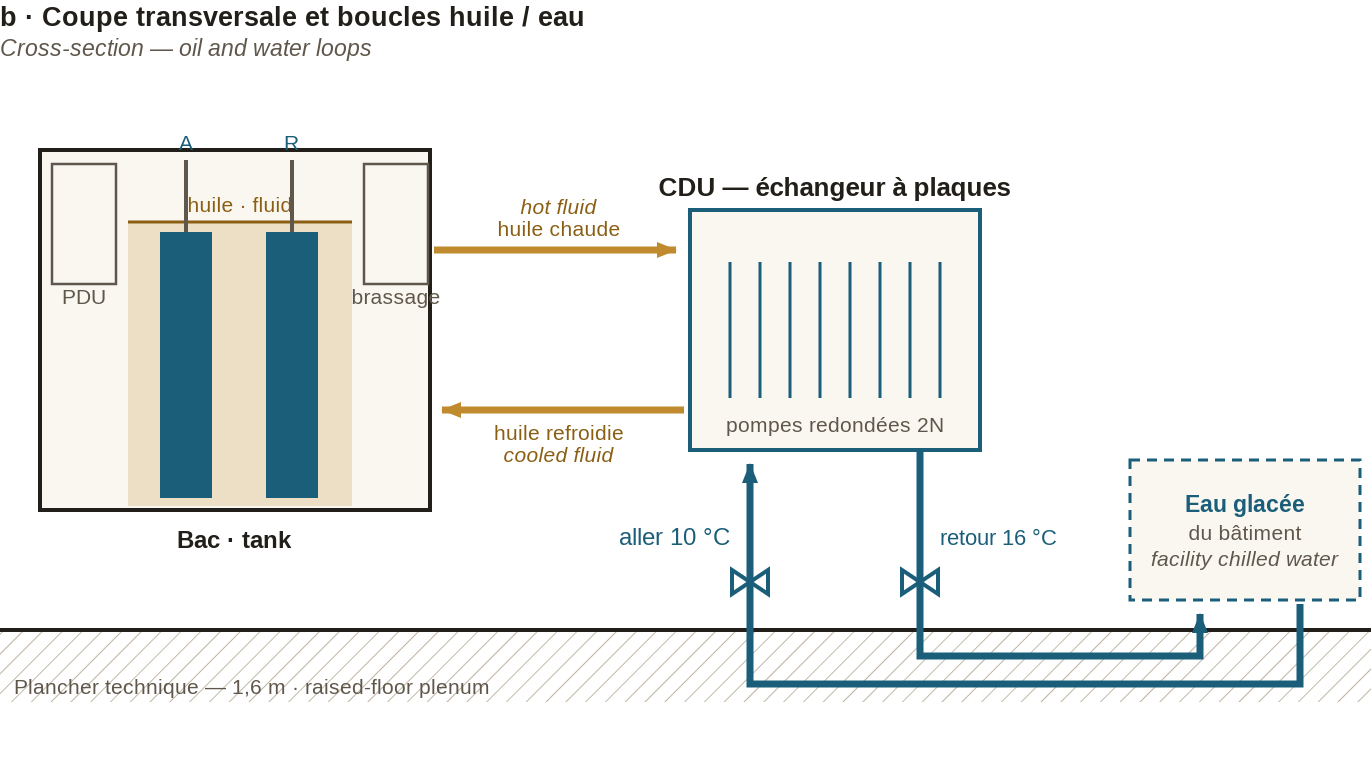
Two dry zones remain outside the fluid: at the front, the power strips — 2 × 63 A / 400 V, four reserved slots; at the rear, the copper and fibre patching. The nodes hang vertically, two per cradle, one power supply for two. Connection to the chilled water under the raised floor, Ø 60 mm valves.
Compute configuration
| Nodes | 14 × Hypertec CIARA TRIDENT iC615DR-G6 |
| Processors | 2 × AMD EPYC 9754 per node — 128 cores, Zen 4c, 2.25 / 3.1 GHz, 256 MB L3 |
| Cores | 3,584 cores · 7,168 threads |
| Memory | 24 × 64 GB per node — 21,504 GB, DDR5-6400 on a 4,800 MT/s platform, 12 channels per socket |
| Network | ConnectX-6 Dx 2 × 100 GbE · E810 2 × 25 GbE · X710 2 × 10 GbE · BMC 1 GbE |
| Operation | OpenStack, OpenInfra stack, shared hosting |
| Installed TDP | 28 × 360 W = 10.1 kW (configurable cTDP 320–400 W) |
Seven RU out of fifty are occupied. RU21 to RU50 are awaiting GPUs in the 21-inch form factor.
The fluid
A plant-based ester — not classified as hazardous, readily biodegradable, with a flash point above 190 °C (ASTM D92), far above any operating temperature. Single-phase: it does not boil, does not evaporate, and the loop consumes no water.
Neither a synthetic hydrocarbon nor a fluorinated compound.
What this page does not say
The other characteristics of the fluid belong to the supplier’s documentation and are not reproduced here, nor is the product’s commercial reference.
Commissioning
Integration from 5 to 7 August 2026. The “dry-to-wet” protocol precedes immersion: removal of every factory label, tape and rubber band, dusting with dry air, optical ports kept out of reach of the fluid. Each node is then immersed powered off under recirculation for 15 to 30 minutes — degassing — before first boot.
At acceptance:
- no thermal throttling observed;
- stable CDU differential flow;
- no ECC memory errors;
- 14 nodes out of 14 enumerated in the BIOS and the BMC.
Next steps
Raise the water temperature. Bring the supply from 10 °C to 16 °C, then aim for free cooling. That is where the energy gain is won, not in the tank.
Measure over an annual cycle. Instrument the loop and publish PUE and ERE season by season: a one-off value says nothing about a site.
Scale up. This tank is the demonstrator for a 1 MW oil-cooled datacentre.
Recover the heat. The campus already has a network fed by Jean Zay. Immersion captures the heat in liquid form, and therefore in a usable form.
Who, and with what
Work presented by the RESINFO Green-IT WG.
David DELAVENNAT (UPS IDCS, École polytechnique, IP Paris; Centre de Mathématiques Laurent Schwartz, UMR 7640, CNRS) · Emmanuel QUEMENER (ENS de Lyon; CPHT, UMR 7644, CNRS) · Vazoumana FOFANA · Yannick FITAMANT · Abdelkarim DELLAL · Rafael MEDEIROS · Xinxin QI · Paulo DIAS · Jean-Marc DENIS · Mickael ALONSO — IDRIS (CNRS), Hypertec, CFI, Submer, Metaline.
Tank funded by E4C · integration by CFI · connection by Metaline · operated under OpenStack run by StackHPC as part of the national Cloud Recherche et Données project, supported by the Direction générale de la recherche et de l’innovation (DGRI) · RESAH procurement contract.
Created on by David DELAVENNAT
Modified on by David DELAVENNAT